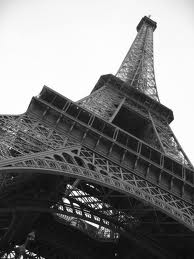
 I experienced very little of my fear of heights traveling up the Eiffel Tower elevator. That's probably because the structure's steel girders and beams wrapped my field of vision in protected safety. The rainy weather shrouded the summit views in an Impressionistic haze but still afforded spectacular views of the city. My favorites were the curved galleries of the Trocadero, the Seine river traffic and the golden dome of the Hotel des Invalides. The Sacre Coeur and Notre Dame Cathedral barely materialized in the distance.
 The summit room also displayed small flag icons showing the directions of various countries and cities. I took some shots of Kuala Lumpur, Malaysia; Manila, Philippines; and Los Angeles, USA.
Second floor views proved even more memorable since we were closer to the ground. In addition, three gift shops offered some last-minute buying opportunities for a three-inch-high metal Eiffel Tower model and an "I Love Paris" t-shirt.
My fear of heights returned as we descended from the summit to the second floor, probably because the downward movement was like falling in slow-motion. The solution was simple -- I simply closed my eyes until we reached our destination.
Eiffel Tower
Rude French?

- They've greeted us with Bon jour, monsieur and bid us Au revoir whenever we entered their stores. We responded in kind.
- They constantly said Pardon for any slight that they perceive they do.
- When we were struggling with maps and directions, some asked us , primarily in English, "Can we help you find something?"
- They complemented us on how good our French is, even when it isn't. I say "Yes, it's French with a strong American accent," they protest and say it is good pronunciation.
- Individual shopkeepers talked to us about their art, their merchandise and even the weather.
- They switch to English when possible, whenever they see us struggling with the language.
Rude Americans
Here's what we've observed about some Americans:
- Some are the loudest people in restaurants and train carriages, their voices echoing through a quiet setting, since they assume nobody can understand their English. More often than not, everyone knows exactly what they're saying, since many French, as well as tourists of other nationalities, understand English.
- They shout orders at food servers or guides in English and get annoyed when the French do not understand their English.
- They enter and exit stores without greeting the shop owners -- a most stores are run by their owners.
Loving the Louvre: Statues vs Paintings

The paintings were great. Some hung by themselves in small rooms with dramatic lighting and others clustered by the hundreds in grand galleries lit by translucent, arched ceilings. Many of the paintings you know from art books and courses were there.
But there's just so many of them. And they're flat. And we'd already seen so many wonderful paintings at so many museums. And there were no Impressionist works because they were too radical to include in the collection.
 |
| Michelangelo's Dying Slave |
 |
| Winged Victory |
When you visit the Winged Victory, look for a small glass case to her left as you face her from the staircase. It contains part of her hand and finger. Most people miss that.
Loving the Louvre: Mona vs Jesus
Introducing the Mona Lisa:

- It is NOT the size of a postage stamp. The picture measures about 20-inches wide by 30-inches high -- about the size of an average portrait. However, it was dwarfed by the free-standing wall on which it hung by itself. It's also guarded by a glass case, a permanent wooden barrier about two feet away and a temporary stanchion rope that is an additional six-to-ten feet away. Add to that about three rows of people, and what you see is much smaller than its press. Just like a man.
- Why do the eyes follow you wherever you go? Because all portraits do that. It's your eyes that are following its eyes, and not vice-versa.
- The painting is dark, just like all of Leonardo's paintings. You can't really make out any of his revolutionary improvements: the hazy, three-dimensional background; the slight veil over her head; the smoothness of her lower face as it melts into the slight smile. You can see all this only in close-up pictures on the Internet.

- People spend far too much time pretending to admire the Mona Lisa while ignoring the dozens of other paintings in the large gallery. The most impressive of these is the Marriage at Cana, on the opposite wall by Veronese, painted in 1563, about 50 years after the Mona Lisa.
- For those unfamiliar with Christian theology, this depicts Christ living it up at a post-wedding party where the hosts ran out of food. He took the remaining bread and fish, and turned it into a feast for all the guests.
- How big is this painting? The foreground figures are life-size.
- You can spend hours admiring every detail. Check out the colorful Renaissance drag, the 120 or so figures, the pets, the food, the classical architecture and the musicians. Veronese himself is fiddling on the left, while Titian is on base.
- While not as bright in real life as in this picture, the work is much more colorful than the Mona Lisa. And you can get close enough to lick the wine pouring off the jar in the lower right.
Loving the Louvre: Introduction
 |
| The glass pyramid leads into an underground entrance. |
And still people try to see it all in one day. Madness.
It's far better to spend two hours to tour the museum's highlights. Travel books of Paris typically have them. We used the one by Rick Steves. His Paris book is available under My Favorites in the right column. Then you can spend the next few days concentrating on individual galleries of interest. The Louvre website boasts several resources for exploring galleries virtually, setting up thematic tours and creating a list of favorite artworks.
At the very least, you need to go to the website to find out when galleries are open. Because the museum is so big, they do not have the staff to guard every room. So only particular galleries are open on particular nights. In our case, we visited Wednesday night (their late nights are generally quiet) to view biggies from the French, Italian, Dutch and Flemish galleries, before going on our highlights tour on Thursday, and finishing up with leftover works today (Sunday).
Despite it being a rainy day during the low season, today revealed the longest line ever for ticket buying. I'm estimating at least one or two hours to buy tickets under the pyramid. And then another 30-minute to one-hour line to get through security.
Our Museum Pass not only allowed us to skip all these lines but saved money for such multi-day excursions. Those waiting patiently in the rain could've avoided the wait by visiting the Louvre website to buy tickets, or by using the automated ticket machine at the Le Carrousel du Louvre, a mall right under the museum.
The food court at the mall is also the best place for lunch. And yes, they have a McDonald's as well as the most beautifully-designed Apple Store that I've seen, with a transparent spiral staircase joining two levels.
 |
| Apple Store at the mall under the Louvre |
Carnavalet Charm

November 5: Because it's free and contained in two relatively small Marais mansions, the Musee Carnavalet is a worthwhile introduction to the history of Paris, particularly the revolutionary years. The city participated in four revolutions: the biggie in 1789, and three more in the 19th century. You'll see monuments and references to all four events throughout the city, and this museum sorts them out for you. However, avoid coming between 12 and 2 PM, when many rooms are closed for lunch or on Monday, when the place is closed.
One caveat: everything is in French, so find a good tour book. The Rick Steves Paris book, linked on the right side of this blog, contains a two-hour tour, or one-hour, if you concentrate on the revolution. Many other travel guides also contain tours.
The walls were chock-full of paintings of French personalities such as Marie Antoinette, Marat and Robespierre. Two toy guillotines made of ivory were among the displays. The first highlight were the city models, particularly of the area around Notre Dame before Baron Haussmann's renovations. The location was a warren of medieval houses and crooked streets before the tore them all down to present a better view of the cathedral.
The second highlight was the full reconstruction of an Art Nouveau shop, both inside and outside, complete with bronze peacocks, stained glass accents and curved framing. I'll let the picture speak for itself.

Pompidou Center: Outside

Like the Eiffel Tower and the Louvre Pyramid, the Pompidou Center was reviled by most Parisiens when it was completed in 1977 but has since been embraced by locals and tourists alike. Its skeleton rises outside the building, allowing maximum space within the structure and the colors have practical meaning. White means support, red signifies electricity, blue is for climate control and green is plumbing.

Just slightly south of the main building, we discovered the kinetic fountains at Stravinsky Place. Fountains spurted out of spinning wheels and rotating pipes, while colorful mosaic creatures stood guard. The broad plaza to the west of the building proved a popular hangout. Teens and tourists strolled and watched international entertainers such as a lady blowing a brown sapling that made digiridoo sounds, a Chinese man singing American songs while strumming an acoustic guitar and an elderly European couple playing stringed instruments.
Cafes and souvenir shops ringed both areas. We found our favorite Amorino Gelato in front of the plaza. We enjoyed our gelato on an outdoor table after our tour of the museum.
Pompidou Center: Inside
The Pompidou Center celebrates modern art with sculptures, paintings, photographs and assemblages.
And I didn't understand most of it.
Art requires that the artist express himself in a language that the viewer can understand. For much of history, both artist and viewer used a common language. Maybe that required learning the language, but once that happened, the art could be appreciated.
With modern art, the artist can use his own language to express himself, and not care whether the viewer understand. The question then becomes what's the point of viewing modern art, if you have no idea what the artist is saying. It's a little like an English speaker trying to understand someone who speaks only Chinese.
In this regard, Picasso seems quaint. I could at least recognize human figures and the irreverence in his work, however distorted.
 |
| La Pisseuese by Pablo Picasso |
 | |
| Double Metamorphosis III by Yaacov Agam |
If you like modern art, then you'll enjoy the Pompidou. If your have a Museum Pass or can otherwise enter the museum for free, spend an hour or two inside, just to say you were there, and so you can see some great views of Paris from the top floor. Otherwise, don't pay to go in and instead enjoy the outdoor spectacle.
Paris Transportation Tip

Even though it's a densely-populated city of two million, Paris is scaled for human beings. The Metro is relatively cheap and walking is a joy.
- Avoid buying the expensive tourist transportation passes, or the resident passes, which is useful only for stays of a month or so.
- Instead, figure out how many times you'll need to use public transportation -- you'll need a ticket to go to and then from your destination. If you're a typical traveler, most of your trips will be within zones 1 and 2, and you'll decide at the last minute to walk rather than ride.
- If you're taking ten or more trips by yourself, buy a carnet (KAR-nay) at any ticket booth, which offers ten tickets at a slight discount. If you're traveling with a partner, the carnet is useful for five trips: just give half of the tickets to each traveler.
- If walking produces hurt feet, try doubling your socks for extra cushioning.
Food Budget
Both tourists and Parisiens consider food in the city to be expensive. For those of you planning a trip to Paris, here's what we typically spend for food. All costs are in American dollars and per person.
- Breakfast - $3. Usually from the corner bakery: a croissant, and a chocolate or cream-filled pastry. We eat this at home, where we have coffee and other drinks.
- Lunch - $11.20. Usually from an overpriced museum shop: a french-bread sandwich costing $7 and a smaller-than-American-size can of Diet Coke at $4.20.
- Dinner - $26 and up. Starting price of a cheap plat du jour (daily combo plate) consisting of three courses, though sometimes we order two courses and eat ice cream elsewhere. Median prices are typically over $53 or more:
- Starters include dried sausage with bread, shrimp and salmon salad, escargot, raw salmon with sauce or a paté.
- Main courses include veal with white sauce, steak tartare, grass-fed lamb, pepper steak, broiled cod.
- Desserts include apricot pie, creme brulée or Berthillon ice cream.
The Orsay is Okay

November 3: Though ensconced within the elaborate facade of a Victorian rail station, the Orsay Museum boasts an airy, white, light-filled interior that pulls it into the 21st century. Rick Steves' Paris guidebook (more info on the right) guided us through sculpture, painting and decorative works from the 19th and early 20th century, failing only at the Impressionist section, which had been moved and reorganized.
Exhibits
One of my favorite exhibits was a scale model of Paris in the 19th century, under a thick, transparent floor. I was afraid of crossing it for fear of breaking the floor, but Anthony walked across it immediately, as did some kids. It was perfectly safe but I kept off.

The model was guarded by yet another scale construction: a cutaway view of the Opera Garnier, so you could see everything from the elaborate lobby, to the seats, to the stage mechanisms.

 | |
| Not at the Orsay because it was on tour. |
One pleasant surprise was a collection of Art Nouveau furniture including entire rooms such as this dining room by Alexandre Charpentier.


The Orsay is Okay: Corpus Christi Lives
November 3: One of my first plays at the now-defunct Rude Guerrilla theater was Corpus Christi, in which playwright Terence McNally explained the story of Christ with gay themes and set it in modern Texas. The following painting, L'Ecole de Platon (Plato's School) by Jean Delville brought back memories of that play.

Colorful Sainte-Chapelle

We climbed a staircase to reach the upper chapel, whose walls were almost entirely of stained glass. Unfortunately, the circular, stained-glass surround around the altar was buried under scaffolding and wood for maintenance. We thus missed the church's most spectacular effect.
It was particularly frustrating since we stood in line for a while to go through security. The church is located in the high-security Palace of Justice complex, with airport-like security measures. The Museum Pass did not allow us to bypass the line, which was annoying, since those who bought tickets could skip the queue.
The Deportation Memorial
 November 2: Well-hidden near the southeast tip of the island containing Notre Dame, was the Memorial to the Martyrs of the Deportation. Created in 1962, this modern monument remembers the 200,000 Jews who were deported from France to the Nazi death camps in World War II. The descent into pits of concrete, occasionally propped up with bars and sculptures of black iron effectively evoked the horror of becoming a prisoner, while 200,000 lighted crystals represent the souls that once lit up the world.
They only allow a few people in at one time, so visitors receive the full impact of the event. Avoid coming from 12 to 2 P.M. when the memorial closes for lunch. Look for makeshift pieces of paper with English translations near some of the French sayings, such as "Forgive but never forget."
Roman Paris

November 2: If you have a Museum Pass, you can get into the Paris Crypt or Archeological Museum for free. It's buried just across the square from Notre Dame. Otherwise,it's not worth admission unless you're a history buff.
You'll find the crumbling foundations of old houses, sewer systems and baths dating back to the 4th century A.D., with scale models showing what the city looked like when the tourists hailed from Rome and spoke Latin. Many of the descriptions exist in English, though the explanatory video is only in French.
Notre Dame, Mon Vertige

November 2: Notre Dame would've been far more impressive, if it hadn't been the umpteenth church that we've visited in France. True, graceful flying buttresses propped up the walls, the interior vaulting rose ten stories from the ground, stone saints hugged the walls and pillars, and stained glass windows added color to an interior darkened by a cloudy day. But it followed the same basilica plan of any French cathedral. A choir practice added a few minutes of atmospheric music although stanchions prevented heathens like us from entering the center aisle and approaching the altar.
At least the church is free, so it should be on the agenda of anyone visiting Paris.
The gargoyles kept things interesting with their monstrous grins and contorted poses. They served three purposes:
- Show worshipers what happens to souls trapped between heaven or hell. (I'm not quite sure how this fits into Catholic theology where the afterlife consists of Heaven, Hell or Purgatory and not some wimpy in-between zone.)
- Ward off evil spirits, which I'm sure they do because of their profusion, if nothing else.
- Drain water from the roof. Watch out for vomiting monsters when you walk by the church on a rainy day!
The tower climb costs but our Museum Pass let us in for free after a twenty-minute wait: only a few people are allowed inside at the same time. We climbed a circular staircase with over 400 steps, broken only by a mid-level gift shop.
The top greeted us with panoramic views of the city and close-up views of the stone monsters guarding the facade.

I then realized we were hundreds of feet in the air, standing on a one-foot wide stone walkway that could collapse any time. The surrounding chain-link wire couldn't protect you then. Or what if a terrorist bomb went off below. The fall would take at least a minute before the impact flattened you into a painful pancake.
Dizziness plus exhaustion plus mon vertige (my vertigo) overwhelmed me.
I waited an eternity for Anthony to reach my perch, where I cowered behind a stone pillar and tried not to look toward the ground. He was happily and slowly taking pictures. When he finally arrived, I thrust my camcorder at him with instructions to take videos of the bell, which hid up some rickety wooden stairs. Then I pushed through the masses of people to find the exit and rushed down.
Monet at the Grand Palais
October 30: If the Monet paintings are missing from your favorite museum, they're probably at the Monet exhibition at the Grand Palais in Paris, which is on until January 24, 2011. This is the first major exposition for the artist in 20 years and pulls together works from museums around the world such as the Heritage in St. Petersburg, Russia; the National Gallery in London; the Metropolitan Museum of Art in New York; the Orsay in Paris; and even the Los Angeles County Museum of Art. Check out the crowds at the entrance.

The half-circle to the right of the black vertical sign on the left have no advanced tickets and are hoping to snag one. The half-circle to the left of the sign are those with advanced tickets for the upcoming half-hour.
The exhibit proved to be stunning for both Anthony, an artist himself, and me, who doesn't think that highly of the splotches known as Impressionist style. Paintings that you could not normally compare because they were on opposite sides of the world, now hung side-by-side. These included the haystacks, London, Gare San Lazare, Venice, the Japanese bridge at Giverney, and Argenteuil among others. For the first time in decades, you could see how a scene was painted at different times of the day or during different seasons. Check the link to see the paintings.
Impressions of Paris

And when we wandered into the cool, cloudy outside, the smell of cigarette smoke assaulted our noses. (France as well as England no longer allows smoking in many buildings.) Many of the smokers seemed barely old enough to have pubic hair but maybe they look so young because I'm so old.
Since this is the first time I'm getting regular Internet access, the entries may seem to come from different dates at first, since I'm trying to catch up on my blog entries.
Previewing Paris
Since we're not going to be in Paris proper until the beginning of next month, here's a little preview of the Eiffel Tower, courtesy of Google Maps street view. You can grab the picture with your cursor and drag it to look around, or click on the path on the street to walk around the site. Click the double-arrows in the lower-right to see a map of where you are. If you'd rather see a larger picture, click "View Larger Map" right after the pic.
View Larger Map
Themes
I don't particularly enjoy wandering aimlessly through a foreign country, lost in the "If it's Monday, it must be Marseilles" syndrome. It's a better use of time and money to have one or more themes for a vacation, to help decide what sights to visit and what to ignore.
Three themes will guide our vacation: art, World War II and food.
Art

One of Anthony's favorite painting styles is Impressionism. However, because this was considered too radical at the time, the Louvre in Paris, arguable the world's greatest art museum, has no Impressionist works. Fortunately, the Orsay, Orangerie and the Marmottan in Paris are chock full of Monets and Manets. (The picture above is Monet's at the Orsay.) The National Gallery and the Tate in London also have good examples. The Grand Palais in Paris is having the "first major exhibition in France of Claude Monet's work in over 30 years" and we have tickets.

As for me, I like Venetian 17th-Century views as in the above example by my favorite artist, Canaletto. The National Gallery in London is having the best assemblage of this painting type since 1967, which is primarily why we're going to London.
World War II

For a UK view of World War II, we're visiting the Churchill War Rooms in London, where the British government hunkered down during that period. But our main journey through the war comes from Bayeux in Normandy, France, where the Battlebus is going to take us on a two-day tour of the era, complete with visits to French, American and German cemeteries; St. Mere Eglise, whose church tower figured prominently in the film "The Longest Day;" and the invasion beaches, where all those poor souls lost their lives loosening the country from the grip of the Nazis.

We're also spending a day at the Caen Memorial Museum, also in Normandy, one of the best museums anywhere. It concentrates on World War II, of course, but has exhibits on all types of conflict including The Cuban Missile Crisis of 1962 and the 9/11 attacks of 2001.
Food

London will prove to be a surprising change from my last trip there decades ago. The food was so bad that I actually lost weight after two weeks there. Fortunately, the city has since become a food capital of Europe, with cuisines from around the world. I'm especially looking forward to all the Arabic edibles, one of my favorites, imported by immigrants from across the Mediterranean.
Others

The entire trip is not going to be thematically based. Like every other tourist, we'll be gawking at the Eiffel Tower, observing the meat-eating crows at the Tower of London, and marveling at the intricate sculptures at Notre Dame. As for Segrie, France, the only reason we're stopping at that farming community in the middle of nowhere is to visit Anthony's old French teacher, who's celebrating his 78th birthday. The last time they saw each other was in Penang, Malaysia, nearly ten years ago. Even then I didn't think the old professor was going to live another ten years. There must be something in French food that makes you last forever.


