Mud and Cookies: Food

Mont Saint Michel is famous for several specialties.

Mère Poulard Galettes. These butter cookies are flat round discs about an inch-and-a-half in diameter. For better prices, Sabrina took us to a factory just before we reached the island: Biscuiterie du Mont Saint Michel, SNC St Aubert, 50170 Ardevon. Tel:  02 33 60 59 48.

Caramel d'Isigny.  Individually-wrapped caramel candies, which we also bought from the same shop. As an aside, Disney's family came from the Isigny (d'Isigny), which may be the origin of the Disney name.

Omelette de la Mère Poulard. This fluffly omelette has a skin similar to a fried egg with a creamy egg filling. Sold everywhere at outrageous prices. Anthony tasted it at Restaurant du Guesclin as part of 18 Euro fixed-priced meal. The restaurant was recommended by Sabrina.


Agneau de Pré-Salé. Salt-marsh lamb refers to sheep that's fed off the grass that grow in the salty marshes around the island.  The so-called distinctive flavor had very little lamb taste and was fairly bland. Or maybe it was the sauce. Also sold everywhere at outrageous prices, though I ate mine as a fixed-price option at the Guesclin.

    Mud and Cookies: The Island


    October 25: The rocky island rose like a fairy settlement in the middle of mudflats during low tide. At high tide, water cut Mont Saint Michel from the mainland, allowing access only through the causeway. The lower parking lot often got flooded when the water was high, so Sabrina parked the shuttle van at the higher one. She stayed with the vehicle, leaving us about three hours to explore.

    Think Lord of the Rings or any medieval fantasy.  The settlement began with a ring of sand-colored houses at the bottom, continued up to fortress walls and topped off with an abbey and church spire. Any roads were narrow and sloping, while staircases connected various levels. Sabrina showed us a secret entrance, where we escaped the tourist hordes while climbing to the top.

    Though people settled on this outcrop as early as the fifth century A.D., the abbey began in the 11th century in the Romanesque style. Though Gothic additions came later, they dominated the interior with vaulted ceilings and pointed-arch windows.  Unless you have a guide book, grab the multi-lingual audio guide, which costs extra over admission. Otherwise, the giant fireplaces, restful cloister and spacious stone rooms will be puzzles since no explanatory labels exist.

    With the exploration of the abbey and a quick lunch, three hours proved to be inadequate for exploring the island. We had no time to wander the town or explore any of the museums. Still I'm glad we left at 1 P.M. The daytrippers from Paris were just arriving, and threatening to clog the narrow passages with humanity.

    Before we returned, Sabrina asked us if we could stop for gas on the highway, since it was hard to find in Bayeux. Since we had no other plans that day, we said yes. She must've spent at least half-an-hour in line at a rest-stop station with multiple pumps -- most them were dry because of the French strike. Fortunately, the van was diesel since those pumps were the only ones working. As for us, we spent most of the time wandering the shops and cafes of the rest-stop.

    Mud and Cookies: Introduction

    Not a good idea.
    October 25: "Stay away from the mud!" Our driver, Sabrina warned. "There's quicksand and the tide can come in too fast for you. All French schoolkids learn that and yet they had to rescue two French tourists last month because they were trapped there."


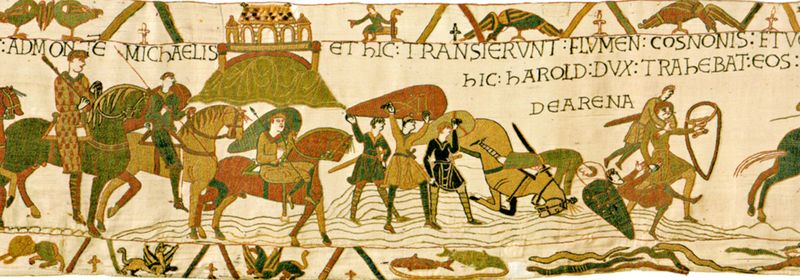
    Even the Bayeux tapestry showed hapless horses and knights trapped in the mud almost 2,000 years ago.

    Sabrina was taking us to Mont Saint Michel via the Hotel Churchill shuttle van. Though she offered color commentary on the sights, she did not have official tourist training, so could only be called a driver, not a guide. She used to work in her husband's architecture office but was laid-off when the French economy soured.

    The round-trip cost 55 Euros per person. It saved a lot of time and aggravation in taking public transportation, which was now intolerable because of the French strike against raising the pension age. Because we were the only two on the eight-person van, it felt like a private tour.  The hotel had earlier asked to move our trip to a different day, since it was not cost effective to drive just two people because of the gas prices and strike shortages. When we couldn't, they went on with the trip since we had reserved so far in advance.

    Bayeux Cathedral


    October 24: Bayeux Cathedral easily dominated its medieval town in terms of importance, size and grandeur. It was originally built in the Norman-Romanesque in 1077 under William the Conqueror and his wife Mathilde. However, after being badly damaged by war in 1105, it was rebuilt in the Gothic style in the 13th century. The intricate facade was dramatically lit during the early-arriving night.

    The interior was not over-run by tourists, and the dominant sound was not the buzz of excited visitors but silence, punctuated by footsteps on hard stone. It seemed like a place of worship rather than a tourist destination. Like any Gothic cathedral, it featured a soaring interior and beautiful stained-glass windows. The sunlight cast patterns of color onto the sand-colored columns and onto the faces of Anthony and me.

    One of the few things remaining from the original construction was the crypt, supported by typical Romanesque arches (as opposed to Gothic pointed vaulting).  I used my portable LED light to view the mural and the paintings of angel musicians decorating the tops of pillars, which were nearly invisible in the dark.

    Medieval Multimedia


    How do you explain a great battle to an illiterate people living in the 11th century? By using the multimedia of the time: embroidered pictures on fabric over 200 feet long.

    The Bayeux Tapestry was sewn most likely by an order of nuns to celebrate/advertise the conquest of the English by the French Normans back in 1066. (About 10 feet of the final scene are missing.) On it, we saw in slightly faded colors, tableaus of knights fighting, horses galloping in formation and servants cooking and serving food, among other scenes of daily life. Latin narration was sewn in to appeal to the literate set. The entire effort was preserved behind glass in a darkened room. Despite warnings against flash, a photographer used hers constantly while snapping pictures, to the annoyance of visitors. No guards were around and just that once, I felt like doing the American thing by yelling at her to stop.

    The museum also showed artifacts and models of the era, including an impressive HO-scale landscape of a fortified manor and village. A short film, with French and English versions, provided background information. A full-scale model of an attack boat provided the only sanctioned photographic opportunity, in the outside courtyard.

    Caen Memorial


    October 24: Arguably the best D-Day museum in an area full of D-Day museums, the Caen Memorial is worth at least at least a three-or-four-hour visit for its comprehensive explanations. Opened only in 1988, the interior is spacious, modern and inventive, and has free baggage-and-coat-check for anyone who can only visit on their way to or from Paris.

    You start down a spiral slope, that literally traces Europe's descent into World War II with pictures, text and multimedia. You then learn about D-Day and the Battle of Normandy though artifacts, models and multimedia presentations.

    The "D-Day" film uses a split screen to present the battle from the Allied and German points of view at the same time. Finally, the museum describes the world after the war, including the Cold War (including a piece of  the Berlin War). Temporary exhibits keep the museum dynamic: we saw one about editorial cartoons that covered everything from Islam to the French economy to ecology.

    A beautiful garden covering Nobel Peace Prize winners surrounded the main building and was visible from the glass walls of the cafeteria. We didn't visit because it was starting to rain heavily.

    Evil French Taxi Drivers

    Beware the silver taxis in front of the train station.
    October 24: To get to the Caen Memorial, a museum dedicated to D-Day, we took a 15-minute train trip from Bayeux to Caen. We could've then walked from the train station, which would've taken close to an hour or taken public transportation, which would've taken about 45 minutes.

    The taxi seemed the fastest option. When we approached a group of three outside the station, their leader told us it would take a minimum of 15 Euro but no more than 20.  We agreed. He then asked us to wait because the next driver in line was having a coffee break -- never mind that two more drivers were immediately available. So we waited a few minutes until the next driver in line was finally available.

    My TomTom GPS told me that this driver was taking the long way around to get to the museum. However, anybody with eyes could see that every time a sign pointed toward the museum, he took the opposite direction. When I asked him why he wasn't taking the most direct route (in as much French as I could muster), he said something about he was going as fast as he could because the direct route wasn't available.The slight tremor in his voice indicated that he knew he was doing wrong and had been caught.

    I didn't know enough French to say that I thought he was taking the long way around to get more money from us.

    We did get to the museum in the fastest way possible, perhaps 15 or so minutes. But if he'd taken the direct, straight road down, he could've done it in half the time. His little detour cost us about 17.8 Euro or so, when it probably should've cost 10. I'm sure most tourists round the sum up to 20 Euro. I gave him a 20-cent tip for a total of 18 Euro to express my displeasure.

    Compare this experience to the one we had with the London taxi.

    The experience so soured us on French taxis that we decided never to take another one. When we returned to the train station in the afternoon, we took a bus and then walked through a rain/hailstorm rather than be cheated again.

    Subscribe via email

    Enter your email address:

    Delivered by FeedBurner

    Paris

    London

    Los Angeles

    Translate this blog

    French Spanish German Italian Russian Portuguese Japanese Korean Arabic Chinese Simplified