Food Budget

Both tourists and Parisiens consider food in the city to be expensive. For those of you planning a trip to Paris, here's what we typically spend for food. All costs are in American dollars and per person.

  • Breakfast - $3. Usually from the corner bakery: a croissant, and a chocolate or cream-filled pastry. We eat this at home, where we have coffee and other drinks.
  • Lunch - $11.20. Usually from an overpriced museum shop: a french-bread sandwich costing $7 and a smaller-than-American-size can of Diet Coke at $4.20.
  • Dinner - $26 and up. Starting price of a cheap plat du jour (daily combo plate) consisting of three courses, though sometimes we order two courses and eat ice cream elsewhere.  Median prices are typically over $53 or more:
    • Starters include dried sausage with bread, shrimp and salmon salad, escargot, raw salmon with sauce or a paté.
    • Main courses include veal with white sauce, steak tartare, grass-fed lamb, pepper steak, broiled cod.
    • Desserts include apricot pie, creme brulée or Berthillon ice cream.

The Trouble with Rodin

Rodin Museum
November 3: Auguste Rodin created the Impressionist version of sculpture: emotional, rough, quickly formed. He wasn't afraid to express the ugly side of his feeling such as with the Burghers of Calais or his many versions of Balzac.

So why wasn't I moved as much as I should have been by the Rodin Museum?

Overexposure.
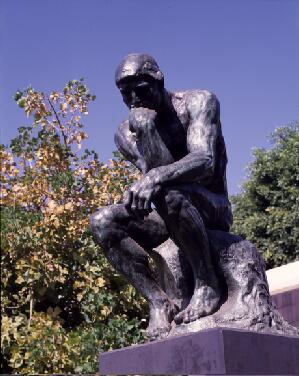
The Thinker at the Norton Simon Museum

I'd seen most of his sculptures before. L.A. County? Balzacs. Norton Simon?  Burghers of Calais, Balzac again and The Thinker. Metropolitan Museum of Art? Burghers of Calais again, Gates of Hell.  Orsay Museum, The Gates of Hell again.
Burghers of Calais at the Metropolitan Museum of Art
He was the Henry Ford of bronzes -- mass-producing and selling all his work. While he certainly deserved to earn all he could from his art, and he did break out of the formal conventions of his era, how many times can one see the Burghers of Calais before saying "Enough!"
Gates of Hell at The Orsay Museum
Anthony enjoyed the museum more than I did, taking pictures of all the maquettes and versions of lovers and hands and women that Rodin sculpted. At least the plaster molds and trials were original.
Finally, some original sculptures at the Rodin Museum.

As for me, I'm glad the museum was a freebie courtesy of the Museum Pass. Otherwise, I would've been annoyed at having paid to see stuff I'd seen many times before.

The Orsay is Okay


November 3: Though ensconced within the elaborate facade of a Victorian rail station, the Orsay Museum boasts an airy, white, light-filled interior that pulls it into the 21st century. Rick Steves' Paris guidebook (more info on the right) guided us through sculpture, painting and decorative works from the 19th and early 20th century, failing only at the Impressionist section, which had been moved and reorganized.

Exhibits

One of my favorite exhibits was a scale model of Paris in the 19th century, under a thick, transparent floor. I was afraid of crossing it for fear of breaking the floor, but Anthony walked across it immediately, as did some kids. It was perfectly safe but I kept off.


The model was guarded by yet another scale construction: a cutaway view of the Opera Garnier, so you could see everything from the elaborate lobby, to the seats, to the  stage mechanisms.
We were disappointed in not being able to find Renoir's masterpiece Bal du Moulin de la Galette, especially since we'd eaten at that very location recently. Apparently, it was on tour in Germany.
Not at the Orsay because it was on tour.
 Surprises

One pleasant surprise was a collection of Art Nouveau furniture including entire rooms such as this dining room by Alexandre Charpentier.
A temporary exhibit introduced me to the paintings of Jean-Léon Gérôme, who liked to paint and sculpt theatrical historical and fantasy scenes. If he'd been alive today, he might be working for a video game company or as a movie matte painter. His most famous work is Police Verso, which traveled all the way from the Phoenix Art Museum.

The Orsay is Okay: Corpus Christi Lives

November 3: One of my first plays at the now-defunct Rude Guerrilla theater was Corpus Christi,  in which playwright Terence McNally explained the story of Christ with gay themes and set it in modern Texas. The following painting, L'Ecole de Platon (Plato's School) by Jean Delville brought back memories of that play.

It's quite interesting that Plato has exactly twelve apostles...I mean students. At 8.5-ft high by 19.8-ft. wide, the painting grabbed our attention the minute we walked into the room.

Colorful Sainte-Chapelle

November 2: Built in only six years (1242-1248), Sainte-Chapelle delighted with colorful paint on the walls and ceilings of the lower chapel. Golden stars decorated vaulted ceilings of blue while burgundy wraps the pillars.

We climbed a staircase to reach the upper chapel, whose walls were almost entirely of stained glass.  Unfortunately, the circular, stained-glass surround around the altar was buried under scaffolding and wood for maintenance. We thus missed the church's most spectacular effect.

It was particularly frustrating since we stood in line for a while to go through security. The church is located in the high-security Palace of Justice complex, with airport-like security measures. The Museum Pass did not allow us to bypass the line, which was annoying, since those who bought tickets could skip the queue.

The Deportation Memorial

November 2: Well-hidden near the southeast tip of the island containing Notre Dame, was the Memorial to the Martyrs of the Deportation. Created in 1962, this modern monument remembers the 200,000 Jews who were deported from France to the Nazi death camps in World War II. The descent into pits of concrete, occasionally propped up with bars and sculptures of black iron effectively evoked the horror of becoming a prisoner, while 200,000 lighted crystals represent the souls that once lit up the world.

They only allow a few people in at one time, so visitors receive the full impact of the event. Avoid coming from 12 to 2 P.M. when the memorial closes for lunch. Look for makeshift pieces of paper with English translations near some of the French sayings, such as "Forgive but never forget."

Roman Paris


November 2: If you have a Museum Pass, you can get into the Paris Crypt or Archeological Museum for free. It's buried just across the square from Notre Dame. Otherwise,it's not worth admission unless you're a history buff.

You'll find the crumbling foundations of old houses, sewer systems and baths dating back to the 4th century A.D., with scale models showing what the city looked like when the tourists hailed from Rome and spoke Latin. Many of the descriptions exist in English, though the explanatory video is only in French.

Subscribe via email

Enter your email address:

Delivered by FeedBurner

Paris

London

Los Angeles

Translate this blog

French Spanish German Italian Russian Portuguese Japanese Korean Arabic Chinese Simplified