Pompidou Center: Outside


Like the Eiffel Tower and the Louvre Pyramid, the Pompidou Center was reviled by most Parisiens when it was completed in 1977 but has since been embraced by locals and tourists alike. Its skeleton rises outside the building, allowing maximum space within the structure and the colors have practical meaning. White means support, red signifies electricity, blue is for climate control and green is plumbing.

Just slightly south of the main building, we discovered the kinetic fountains at Stravinsky Place.  Fountains spurted out of spinning wheels and rotating pipes, while colorful mosaic creatures stood guard.  The broad plaza to the west of the building proved a popular hangout. Teens and tourists strolled and watched international entertainers such as a lady blowing a brown sapling that made digiridoo sounds, a Chinese man singing American songs while strumming an acoustic guitar and an elderly European couple playing stringed instruments.

Cafes and souvenir shops ringed both areas. We found our favorite Amorino Gelato in front of the plaza. We enjoyed our gelato on an outdoor table after our tour of the museum.

Pompidou Center: Inside

The Pompidou Center celebrates modern art with sculptures, paintings, photographs and assemblages.

And I didn't understand most of it.

Art requires that the artist express himself in a language that the viewer can understand. For much of history, both artist and viewer used a common language. Maybe that required learning the language, but once that happened, the art could be appreciated.

With modern art, the artist can use his own language to express himself, and not care whether the viewer understand. The question then becomes what's the point of viewing modern art, if you have no idea what the artist is saying.  It's a little like an English speaker trying to understand someone who speaks only Chinese.

In this regard, Picasso seems quaint. I could at least recognize human figures and the irreverence in his work, however distorted.

La Pisseuese by Pablo Picasso
And some of the art I could admire because it was technically proficient and attractive. Such as Double Metamorphosis by Yaacov Agam, which looked like a black painting from the side but revealed colors and shapes as you walked by an looked through slats.

Double Metamorphosis III by Yaacov Agam
But what could I make of assemblages of garbage, or random squiggles on canvas or random materials and shapes thrown on the floor. These were neither comprehensible nor attractive, and much of the Center's art was like that.

If you like modern art, then you'll enjoy the Pompidou. If your have a Museum Pass or can otherwise enter the museum for free, spend an hour or two inside, just to say you were there, and so you can see some great views of Paris from the top floor. Otherwise, don't pay to go in and instead enjoy the outdoor spectacle.

Paris Transportation Tip


Even though it's a densely-populated city of two million, Paris is scaled for human beings.  The Metro is relatively cheap and walking is a joy.
  • Avoid buying the expensive tourist transportation passes, or the resident passes, which is useful only for stays of a month or so. 
  • Instead, figure out how many times you'll need to use public transportation -- you'll need a ticket to go to and then from your destination. If you're a typical traveler, most of your trips will be within zones 1 and 2, and you'll decide at the last minute to walk rather than ride.
  • If you're taking ten or more trips by yourself, buy a carnet (KAR-nay) at any ticket booth, which offers ten tickets at a slight discount. If you're traveling with a partner, the carnet is useful for five trips: just give half of the tickets to each traveler.
  • If walking produces hurt feet, try doubling your socks for extra cushioning.

Food Budget

Both tourists and Parisiens consider food in the city to be expensive. For those of you planning a trip to Paris, here's what we typically spend for food. All costs are in American dollars and per person.

  • Breakfast - $3. Usually from the corner bakery: a croissant, and a chocolate or cream-filled pastry. We eat this at home, where we have coffee and other drinks.
  • Lunch - $11.20. Usually from an overpriced museum shop: a french-bread sandwich costing $7 and a smaller-than-American-size can of Diet Coke at $4.20.
  • Dinner - $26 and up. Starting price of a cheap plat du jour (daily combo plate) consisting of three courses, though sometimes we order two courses and eat ice cream elsewhere.  Median prices are typically over $53 or more:
    • Starters include dried sausage with bread, shrimp and salmon salad, escargot, raw salmon with sauce or a paté.
    • Main courses include veal with white sauce, steak tartare, grass-fed lamb, pepper steak, broiled cod.
    • Desserts include apricot pie, creme brulée or Berthillon ice cream.

The Trouble with Rodin

Rodin Museum
November 3: Auguste Rodin created the Impressionist version of sculpture: emotional, rough, quickly formed. He wasn't afraid to express the ugly side of his feeling such as with the Burghers of Calais or his many versions of Balzac.

So why wasn't I moved as much as I should have been by the Rodin Museum?

Overexposure.
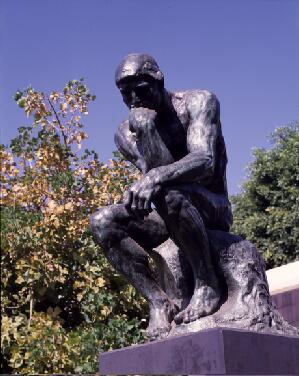
The Thinker at the Norton Simon Museum

I'd seen most of his sculptures before. L.A. County? Balzacs. Norton Simon?  Burghers of Calais, Balzac again and The Thinker. Metropolitan Museum of Art? Burghers of Calais again, Gates of Hell.  Orsay Museum, The Gates of Hell again.
Burghers of Calais at the Metropolitan Museum of Art
He was the Henry Ford of bronzes -- mass-producing and selling all his work. While he certainly deserved to earn all he could from his art, and he did break out of the formal conventions of his era, how many times can one see the Burghers of Calais before saying "Enough!"
Gates of Hell at The Orsay Museum
Anthony enjoyed the museum more than I did, taking pictures of all the maquettes and versions of lovers and hands and women that Rodin sculpted. At least the plaster molds and trials were original.
Finally, some original sculptures at the Rodin Museum.

As for me, I'm glad the museum was a freebie courtesy of the Museum Pass. Otherwise, I would've been annoyed at having paid to see stuff I'd seen many times before.

The Orsay is Okay


November 3: Though ensconced within the elaborate facade of a Victorian rail station, the Orsay Museum boasts an airy, white, light-filled interior that pulls it into the 21st century. Rick Steves' Paris guidebook (more info on the right) guided us through sculpture, painting and decorative works from the 19th and early 20th century, failing only at the Impressionist section, which had been moved and reorganized.

Exhibits

One of my favorite exhibits was a scale model of Paris in the 19th century, under a thick, transparent floor. I was afraid of crossing it for fear of breaking the floor, but Anthony walked across it immediately, as did some kids. It was perfectly safe but I kept off.


The model was guarded by yet another scale construction: a cutaway view of the Opera Garnier, so you could see everything from the elaborate lobby, to the seats, to the  stage mechanisms.
We were disappointed in not being able to find Renoir's masterpiece Bal du Moulin de la Galette, especially since we'd eaten at that very location recently. Apparently, it was on tour in Germany.
Not at the Orsay because it was on tour.
 Surprises

One pleasant surprise was a collection of Art Nouveau furniture including entire rooms such as this dining room by Alexandre Charpentier.
A temporary exhibit introduced me to the paintings of Jean-Léon Gérôme, who liked to paint and sculpt theatrical historical and fantasy scenes. If he'd been alive today, he might be working for a video game company or as a movie matte painter. His most famous work is Police Verso, which traveled all the way from the Phoenix Art Museum.

The Orsay is Okay: Corpus Christi Lives

November 3: One of my first plays at the now-defunct Rude Guerrilla theater was Corpus Christi,  in which playwright Terence McNally explained the story of Christ with gay themes and set it in modern Texas. The following painting, L'Ecole de Platon (Plato's School) by Jean Delville brought back memories of that play.

It's quite interesting that Plato has exactly twelve apostles...I mean students. At 8.5-ft high by 19.8-ft. wide, the painting grabbed our attention the minute we walked into the room.

Subscribe via email

Enter your email address:

Delivered by FeedBurner

Paris

London

Los Angeles

Translate this blog

French Spanish German Italian Russian Portuguese Japanese Korean Arabic Chinese Simplified