This is Not a Drill

October 22: The terrorists were threatening mayhem since before our trip. It worried Mom, but we didn't give it a second thought. For one thing, we were in London, and their hijinks were planned for France.

We descended into the rooms used by the British government during World War II.  Prime Minister Winston Churchill didn't like it there, preferring to be above-ground with his people.  One of his typical argument strategies was pretending to go deaf when someone said something he didn't agree with.  But that didn't work here, since the entire cabinet was forced underground for defense.

Life was cramped, with tedium broken only by the constant work of running the war. We saw map rooms, bunks and equipment necessary for winning the war. A special locked door tagged as a restroom could only be used by Churchill. This convinced everyone that he rated a private bathroom -- a luxury when several people needed to share limited facilities.

Actually, the room contained a phone -- the first hot line to the U.S. President. There, both Churchill and Roosevelt could discuss their plans in absolute secrecy.

About half of the museum was devoted to Churchill's personal life. For example, he was the son of a British lord and an American heiress, who mostly ignored him as he was shipped off to boarding schools.

Just as I was about to delve deeper into his post-war career, the lights suddenly went out. Then, dim emergency lights came on.

A member of the staff came out and asked us to sit tight. They would make a decision on whether to close the museum as soon as they found out what was wrong. In the back of my mind, I wondered if terrorists had carried out their threats. The uncertain atmosphere gave us a taste of what World War II must have been like down there.

I used my mini-LED flashlight to illuminate some of the display cases. But since most of the exhibits were interactive and computer-controlled, we could do very little but sit and wait.

Eventually, the staffer came out again and apologized for closing the museum. A substation went out and the entire neighborhood was dark. We would need to get tickets to return or refunds.  We chose the latter because we were leaving for France the next day.

Visiting the Tower of London


October 22: Though its dwarfed by the modern buildings around it, the Tower of London still imposed itself on the city as a mass of stone and history. But the scaffolding and protective sheeting that climbed many of its walls made it seem a tad vulnerable.

As soon as the Tower opened, we rushed to the Crown Jewels to avoid the crowds. Judging from the Disneyesque stanchions in that area, lines of people in the high season would be horrendous.

You'd think the lady in us would enjoy the displays of diamonds, golds and precious stones. But since everything used the same Baroque royal style, one crown pretty much looked like the next. Or maybe the jewels proved ultimately incomprehensible because it would be hard to plan outfits to match such accessories. We spent more time winding through the stanchions and barriers than actually viewing the jewels themselves.

The man in us enjoyed the armory displays at the White Tower. Swords, axes, shields and knightly wear came in all shapes and sizes, even for children. Anthony enjoyed the few samurai armor pieces which were gifted to some king.
Nowadays, women can be beefeaters, though they're still a minority. Our guide was male.
Definitely worthwhile was the included one-hour tour by a beefeater, the blue-and-red-robed guardians of the Tower. With theatrical flair and a booming voice, our bearded guide clued us in to the historical machinations of this royal palace. He invited small kids to stand in front, so he could occasionally frighten them with loud emphasis or by comparing their ages to those of the boy princes who were murdered at the Tower.

We liked him a lot.

Lunch at the site cafe was both filling and reasonably-priced at 15 pounds for the two of us. I enjoyed a large sausage pastry, french fires with some Diet Coke, while Anthony ate cod and fries.

Apologies

Sorry for not updating my vacation. We made it to the UK but cannot find good and cheap Internet. I am sending this from my Kindle temporarily. Hopefully, France will be better.bet

Where's Rembrandt?

October 21: Southern California boasts the third largest collection of Rembrandt paintings in the U.S., behind Washington D.C. and New York. And yet that amounts to only 15 works spread out over five museums.  The National Gallery in London boasts about 20, with most in one room. Multiply that number by the number of great artists that you know: Titian, Veronese, Turner, Monet, etc, and you'll understand why I wandered the museum with my mouth open in wonder.


I violated my rule of never spending more than two or three hours at a museum because of the quality and quantity of work.  Not a good idea because even with a lunch break, we experienced the paintings as one tiresome mass by the afternoon. The necessary audio guide didn't help, since it described nearly every one of the 1,500 or so paintings. A better strategy would've been to follow a highlight tour from Rick Steves' travel guides or from the museum. Or to break up the visit across several days, since the museum is free anyway (though the audio guide is not).

Still, I felt privileged to be able to view works that I've seen only through picture books.

War Horse


October 20: Finding British productions in London proved a challenge for me because American shows dominated with such stalwarts as Grease, Sweet Charity and Jersey Boys. The Shakespeare season was over and I'd already seen Blood Brothers and Les Miserables on my last London trip.

Typical for London theater, War Horse was well-directed and well-acted, with excellent production values.  It didn't look like any of the performers had microphones, yet they projected their voices clearly and loudly throughout the New London Theatre.  Then again, we sat in the second row from the stage.

In an effort to look fancy, I wore my Chinese jacket with a dragon design and a mandarin-collar shirt. But jeans and collar-less shirts were more common than suits. So the looks I got may have come from incredulity rather than admiration. Also typical for London theater were the overpriced snacks and ice cream that they sold at the seats during intermission. You weren't supposed to bring outside food in but several people did so with no problems from the staff.


A story about a boy and his horse during World War I, the production excelled and delighted with full-sized puppets of horses. Operated by three puppeteers, the animals expressed their own personalities and interacted realistically with the human actors. Many of the horses could even be mounted and ridden across the stage. Puppet birds sometimes flew across the seats and a puppet goose, who kept trying to get into the farmhouse, nearly stole the show.

Special effects kept the interest level high for the many kids in the audience. The drama used dance, projections, make-up, symbolism and even a full-sized tank to effectively express the horrors of war. My only criticism is the major coincidence that acted as the story's pivotal plot point. However, the play reduced the teen boys in the audience as well as me to tears.

If you have a chance, catch the production while you can.  It's already been extended once. Maybe it will come to America some day.

The Courtauld Gallery: Short and Sweet

London cabs all still look like this.
October 20: The London cabbie estimated an 8-pound fare to reach the Courtauld Gallery, so we got into the cavernous passenger compartment of the black taxi. He rushed through the traffic and got us through the traffic so quickly that the meter showed only 6.8 pounds. We gave him 8 pounds anyway for doing what every taxi driver should: taking his passengers to a destination in the shortest route and in the fastest time. (You can compare this to our experience with a French taxi driver in Caen.)


I have to agree with the Gallery's advertising as being "one of the finest small museums in the world." Located in the stylish 18th-century Somerset House, the museum displayed art from the Renaissance to Post-Impressionism. It was also small enough for viewing every painting in one visit, with enough time to enjoy the modern central fountains, which varied its spray patterns in rows and columns. (The gallery occupies a wing of the mansion.)

The museum's Impressionist/Post-Impressionist collection was particularly exciting:  Van Gogh, Renoir, Monet, Seurat and Gauguin, among others.  The highlight was Manet's A Bar at the Folies-Bergère. We can all relate to this woman's feeling for her job:

Visiting History at the British Museum

October 20: What do I write about when discovering two million years of world history that's been donated, bought or looted? The Rosetta Stone, key to deciphering Egyptian hieroglyphics? Entire facades of long-forgotten Assyrian temples, complete with writing that looks like chicken feet and two-story-high man-horses? Intricate Japanese samurai armor from the 15th century?

You can find out about all this at the stuff at the British Museum website.

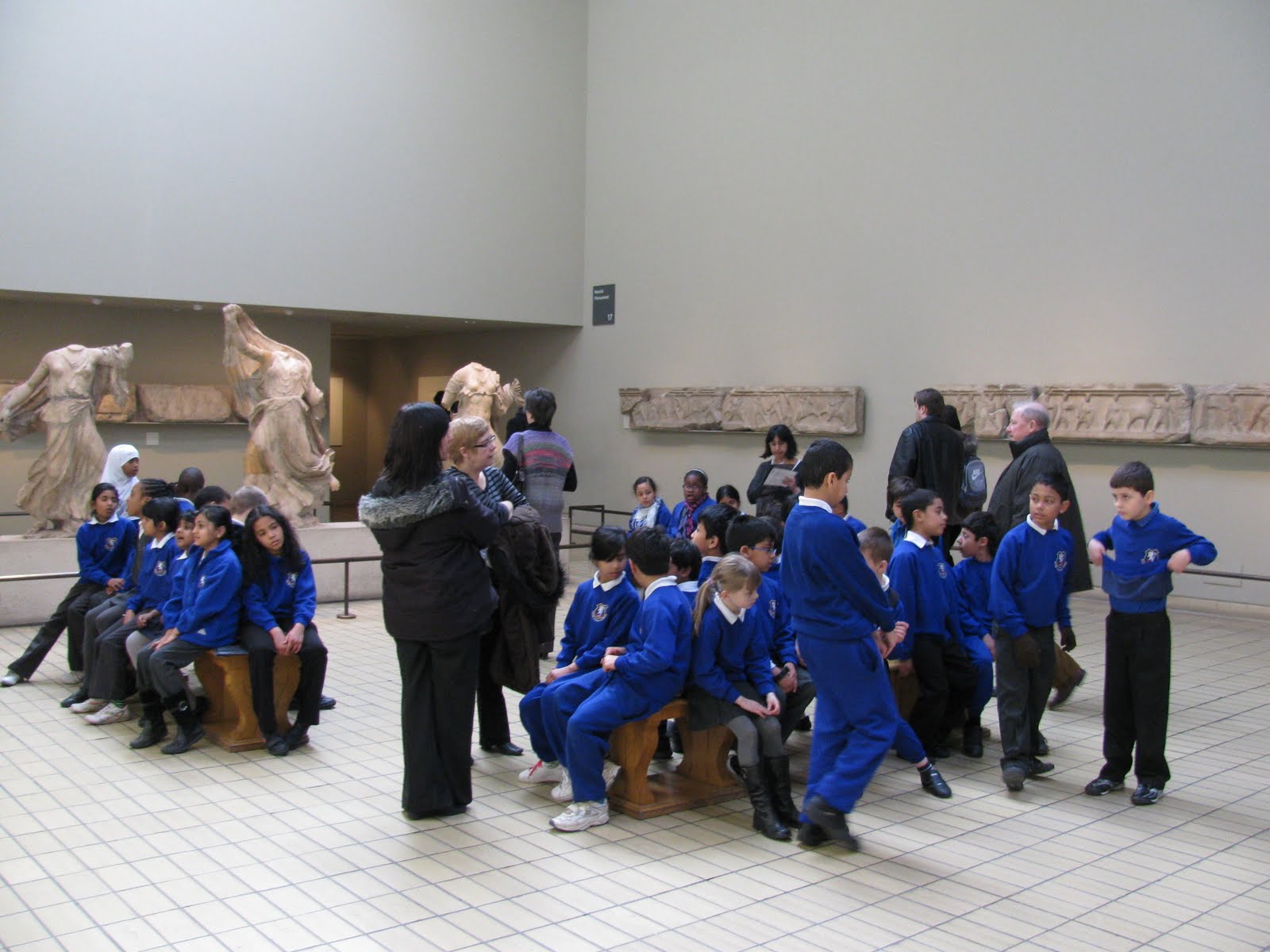
One thing you won't find is information on all the uniformed schoolkids that crowd around the exhibits. They bring a noisy energy to the halls, crowding around exhibits and trying to scratch out notes and drawings on their pads. They're often more entertaining to watch and photograph, as they encounter these precious objects for the first time.


If they block your views, just wait a few minutes because they come and go in waves. You'll then have a few minutes of peace at a display before the next gaggle of children comes tumbling in.

The museum is free, so don't try to see everything at once. The website has information on how to plan a visit and allows you to browse the collections, so you can come back on a different day for a particular interest.

Subscribe via email

Enter your email address:

Delivered by FeedBurner

Paris

London

Los Angeles

Translate this blog

French Spanish German Italian Russian Portuguese Japanese Korean Arabic Chinese Simplified