If you don't like the weather in Normandy, just wait a few minutes. This area to the north of Paris and bordering the North Sea braces visitors with constantly changing weather. In the course of a few hours, we've experienced bright sun, cloud cover, drizzle, pouring rain, thunderstorms and hail, seemingly in random order.
If it's sunny, bring a raincoat or umbrella. If it's cold and wet, dress in layers so you can shed your clothing when the weather gets warm.
Normandy Weather
D-Day: Pointe du Hoc

October 27: Just before D-Day on June 6, 1944, the Allies carpeted Pointe du Hoc with bombs to take out six 155mm guns that the Germans had captured from the French. Because the point was between Omaha and Utah beaches, Germans could easily fire on any advancing troops. Rangers were then sent to scale the 100-foot cliffs to take out the concrete emplacements that held both the guns and the Germans.
Unfortunately, because of weather, the Allied assault that was supposed to take place before sunrise, happened 40 minutes later in full sunlight. The over-220 men who started out were reduced to about 90 by the end of the day. In addition, they discovered that the Germans had moved the guns about a mile inland and replaced them with decoys. The Rangers eventually found the guns and destroyed them with thermite grenades.
All that leads to a modern memorial park that is peppered with bomb craters about 10-15 feet deep. (They used to be about six or seven feet deeper but 60 years of erosion has filled them in and softened them with grass.)
View Larger Map
 | |
| Cratered landscape with remains of a concrete bunker. |
 | |
| Anthony at the bottom of a crater. |


D-Day: Battlebus
 |
| Trevor showing off German barbed wire. The closely spaced barbs make the wire harder to grip and remove. |
Battlebus is based out of Bayeux and specializes in one and two-day tours of the D-Day invasion sites. We chose the two-day American Experience because of its comprehensive view of the event, and its visits to the German side. Additional tours cover the British and Canadian sectors, with specials for World War II veterans.
 |
| Typical Battlebus van. |
I recommend the company highly. But they only accept payment in cash, primarily in Euro. (There are enough ATMs in Bayeux that this isn't a problem.) They will take dollars and pounds but only with expensive exchange fees.
Stay tuned for more details.
Mud and Cookies: Food
Mont Saint Michel is famous for several specialties.
 .
.


Agneau de Pré-Salé. Salt-marsh lamb refers to sheep that's fed off the grass that grow in the salty marshes around the island. The so-called distinctive flavor had very little lamb taste and was fairly bland. Or maybe it was the sauce. Also sold everywhere at outrageous prices, though I ate mine as a fixed-price option at the Guesclin.
Mud and Cookies: The Island

October 25: The rocky island rose like a fairy settlement in the middle of mudflats during low tide. At high tide, water cut Mont Saint Michel from the mainland, allowing access only through the causeway. The lower parking lot often got flooded when the water was high, so Sabrina parked the shuttle van at the higher one. She stayed with the vehicle, leaving us about three hours to explore.

Though people settled on this outcrop as early as the fifth century A.D., the abbey began in the 11th century in the Romanesque style. Though Gothic additions came later, they dominated the interior with vaulted ceilings and pointed-arch windows. Unless you have a guide book, grab the multi-lingual audio guide, which costs extra over admission. Otherwise, the giant fireplaces, restful cloister and spacious stone rooms will be puzzles since no explanatory labels exist.
With the exploration of the abbey and a quick lunch, three hours proved to be inadequate for exploring the island. We had no time to wander the town or explore any of the museums. Still I'm glad we left at 1 P.M. The daytrippers from Paris were just arriving, and threatening to clog the narrow passages with humanity.
Before we returned, Sabrina asked us if we could stop for gas on the highway, since it was hard to find in Bayeux. Since we had no other plans that day, we said yes. She must've spent at least half-an-hour in line at a rest-stop station with multiple pumps -- most them were dry because of the French strike. Fortunately, the van was diesel since those pumps were the only ones working. As for us, we spent most of the time wandering the shops and cafes of the rest-stop.
Mud and Cookies: Introduction
 |
| Not a good idea. |
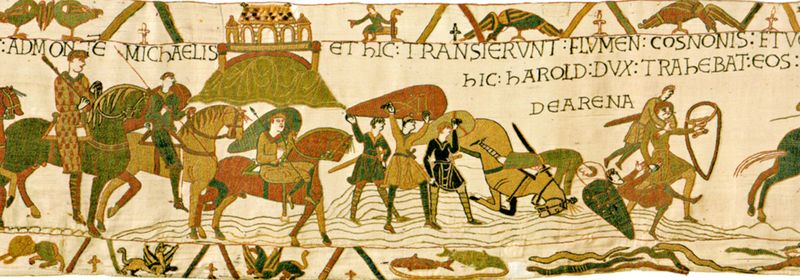
Even the Bayeux tapestry showed hapless horses and knights trapped in the mud almost 2,000 years ago.
Sabrina was taking us to Mont Saint Michel via the Hotel Churchill shuttle van. Though she offered color commentary on the sights, she did not have official tourist training, so could only be called a driver, not a guide. She used to work in her husband's architecture office but was laid-off when the French economy soured.
The round-trip cost 55 Euros per person. It saved a lot of time and aggravation in taking public transportation, which was now intolerable because of the French strike against raising the pension age. Because we were the only two on the eight-person van, it felt like a private tour. The hotel had earlier asked to move our trip to a different day, since it was not cost effective to drive just two people because of the gas prices and strike shortages. When we couldn't, they went on with the trip since we had reserved so far in advance.
Bayeux Cathedral

October 24: Bayeux Cathedral easily dominated its medieval town in terms of importance, size and grandeur. It was originally built in the Norman-Romanesque in 1077 under William the Conqueror and his wife Mathilde. However, after being badly damaged by war in 1105, it was rebuilt in the Gothic style in the 13th century. The intricate facade was dramatically lit during the early-arriving night.

The interior was not over-run by tourists, and the dominant sound was not the buzz of excited visitors but silence, punctuated by footsteps on hard stone. It seemed like a place of worship rather than a tourist destination. Like any Gothic cathedral, it featured a soaring interior and beautiful stained-glass windows. The sunlight cast patterns of color onto the sand-colored columns and onto the faces of Anthony and me.
One of the few things remaining from the original construction was the crypt, supported by typical Romanesque arches (as opposed to Gothic pointed vaulting). I used my portable LED light to view the mural and the paintings of angel musicians decorating the tops of pillars, which were nearly invisible in the dark.


